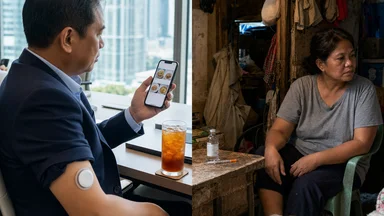
Type 2 diabetes travels through a city like a silent river, carving different channels through different neighborhoods. In Jakarta, Indonesia, a 42-year-old banker might learn of his elevated blood sugar during a routine corporate checkup, his HbA1c hovering around 7.2 percent, and walk out with a prescription for metformin and a referral to a nutritionist. Across the Java Sea, in a Manila shantytown, a 50-year-old market vendor may only discover she has diabetes when a foot ulcer sends her to an emergency room, her HbA1c already above 11 percent.
Both patients share the same underlying pathology—insulin resistance and progressive beta-cell failure—but their clinical trajectories could not be more different. The divergence is not a matter of genetics alone; it is written into the urban landscape. In Jakarta, the built environment features air-conditioned high-rises with elevator banks and sedentary office layouts, while Manila's informal settlements lack basic infrastructure like refrigeration and clean water. The food system in Jakarta offers delivery of fried rice and sweet iced tea to desks, whereas Manila's slums rely on instant noodles and deep-fried street snacks from sari-sari stores. Health-care delivery models range from corporate wellness programs with continuous glucose monitors in Jakarta to understocked public health centers in Manila where glucometers are scarce. This article traces those divergences through patient stories and epidemiological data, asking what the vertical slice of a city reveals about a disease we too often treat as uniform.
The Same Disease, Two Urban Worlds
Jakarta and Manila are both sprawling, congested capitals with high rates of type 2 diabetes. According to the International Diabetes Federation, Indonesia had an estimated 10.7 million adults with diabetes in 2021, while the Philippines counted 4.3 million. But the urban ecology of each city shapes who gets sick, when they are diagnosed, and how they fare.
In Jakarta's central business district, office workers spend 10 to 12 hours a day in air-conditioned high-rises, moving between desk, elevator, and car. Lunch is often ordered via delivery app—fried rice, fried chicken, sweet iced tea. A 2023 study in BMJ Open Diabetes Research & Care found that Jakarta office workers averaged fewer than 4,000 steps per day on workdays. The combination of prolonged sitting, high-calorie convenience meals, and chronic stress creates a metabolic environment ripe for insulin resistance.
In Manila's informal settlements, the landscape is different. Homes are makeshift, often without reliable electricity or running water. Residents walk to fetch water, take jeepneys to market, and perform manual labor—street vending, construction, domestic work. That physical activity offers some metabolic protection, but it is inconsistent and often exhausting. Food is cheap and calorie-dense: instant noodles, white rice, deep-fried snacks. A 2022 survey by the Philippine Department of Science and Technology found that over 60 percent of households in Metro Manila slums consumed sugary drinks daily. Food insecurity means feast-or-famine eating patterns that can destabilize glucose control.
Both populations share rising prevalence of type 2 diabetes, but the clinical presentation diverges sharply. Jakarta's tower dwellers tend to be diagnosed earlier, with milder hyperglycemia and more obesity. Manila's shack residents are often diagnosed late, at normal or low body weight, with severe metabolic decompensation. The disease, it turns out, adapts to its zip code.
Jakarta Towers: Glucose Spikes in Glass and Steel
Consider the case of Andi (a pseudonym), a 42-year-old banker in a Jakarta high-rise. He is 175 cm tall and weighs 86 kg, giving him a body mass index of 28—overweight by Asian standards. He has no symptoms, but his company's annual health screening flags a fasting glucose of 140 mg/dL and an HbA1c of 7.2 percent. His doctor prescribes metformin, recommends dietary changes, and schedules a follow-up in three months.
Andi's experience is typical for his demographic. Private clinics in Jakarta's business district offer continuous glucose monitors, lipid panels, and liver ultrasound. A 2024 audit of three private clinics in the Sudirman Central Business District found that roughly 70 percent of newly diagnosed diabetes patients had non-alcoholic fatty liver disease (NAFLD) detected incidentally on imaging. NAFLD is now recognized as a hepatic manifestation of metabolic syndrome, and its prevalence in Jakarta's white-collar workers is high, driven by sedentary lifestyle and diets rich in refined carbohydrates and fructose.
Treatment for patients like Andi is relatively straightforward. Oral medications are affordable for those with private insurance or corporate health plans. Many doctors prescribe metformin plus a sulfonylurea or, increasingly, an SGLT-2 inhibitor or GLP-1 agonist. A 2025 analysis of prescription data from Jakarta's private clinics showed that roughly 15 percent of patients with type 2 diabetes were on a GLP-1 receptor agonist, a proportion that has been rising steadily.
But the convenience of care has a downside. Andi may never feel the urgency to change his lifestyle because his numbers are only moderately elevated. He might skip doses, eat out frequently, and skip exercise. A 2023 study in Diabetes Research and Clinical Practice found that adherence to oral medications among Jakarta office workers was around 60 percent at one year. The disease progresses silently, often toward NAFLD, early nephropathy, and cardiovascular complications that are detected only on lab tests—silent organs, quiet damage.
Manila Shacks: Late Diagnosis Under Corrugated Roofs
Now consider Maria (also a pseudonym), a 50-year-old market vendor living in a shantytown along the Pasig River in Manila. She is 152 cm tall and weighs 48 kg—a BMI of 22, well within the normal range. She has been feeling tired and thirsty for months, drinking water constantly, urinating frequently. She attributes it to the heat and her long work hours. One day she notices a small cut on her foot that will not heal. After two weeks, the wound turns black and foul-smelling. She goes to the district hospital, where her blood glucose is found to be 380 mg/dL and her HbA1c is 11.3 percent. She is diagnosed with type 2 diabetes and a neuropathic foot ulcer. She spends the next month in the hospital, undergoing debridement and intravenous antibiotics. Her foot is saved, but she loses two toes.
Maria's story is not unusual. A 2022 survey by the Philippine Diabetes Association found that roughly 40 percent of newly diagnosed diabetes patients in Metro Manila public hospitals already had at least one complication at the time of diagnosis—most commonly neuropathy or retinopathy. Public health centers in the city's poorest districts often lack glucometers and test strips; blood sugar is checked only when symptoms are severe. A 2024 report from the Philippine Department of Health noted that fewer than 30 percent of primary-care facilities in Metro Manila's informal settlements had functional HbA1c testing capacity.
Maria's diabetes is not driven by obesity. The phenomenon of "lean diabetes" is well documented in South and Southeast Asia, where individuals with normal BMI develop insulin resistance due to low muscle mass, high visceral fat, and poor beta-cell function. A 2021 study in The Lancet Diabetes & Endocrinology found that roughly 60 percent of Asian diabetes patients have a BMI below 27, compared with only 30 percent in Western populations. Maria's body type masked her risk; clinicians did not screen her because she did not look like a typical diabetes patient.
Treatment access is a second blow. Maria is prescribed metformin at the hospital, but when she returns to her local health center, the supply is intermittent. She cannot afford the out-of-pocket cost of sulfonylureas or insulin. Insulin requires refrigeration, which many shanties lack. A 2023 study in PLOS ONE found that only 40 percent of households in Metro Manila slums had consistent access to a refrigerator. Patients often store insulin in a neighbor's fridge or in a communal cooler at the sari-sari store, but temperature excursions are common. A 2022 audit by the Philippine Pharmacists Association found that roughly 30 percent of insulin vials sampled from urban poor communities had degraded due to improper storage. Cost is another barrier: a vial of insulin costs roughly US$10–15, significant for a family living on US$100–200 per month. A 2023 study in The Lancet Global Health estimated that roughly 40 percent of Filipino diabetes patients reported skipping or underdosing insulin due to cost. A 2023 analysis by the Philippine Institute for Development Studies found that out-of-pocket spending on diabetes care accounted for roughly 15 percent of household income among the urban poor. Many patients, like Maria, ration their medications—taking half a tablet instead of a full dose—or stop altogether when symptoms improve.
Treatment Access: Insulin in a Penthouse vs a Sari-Sari Store
The gap in treatment access between Jakarta's towers and Manila's shacks is stark. In Jakarta, patients with private insurance can access insulin pumps, continuous glucose monitors, and the latest oral agents. A 2024 survey of endocrinologists in Jakarta found that roughly 10 percent of their patients with type 1 diabetes used insulin pumps; for type 2, the figure was lower but rising. GLP-1 agonists such as semaglutide are available in branded and generic forms, costing roughly US$50–80 per month out of pocket—within reach for many professionals.
In Manila's informal settlements, the picture is different. Oral medications are not immune to barriers. Metformin is cheap—roughly US$2–5 per month—but supply chain disruptions are common. A 2024 investigation by the Philippine Daily Inquirer found that public health centers in Metro Manila experienced stockouts of metformin for an average of two months per year. Patients who cannot afford private pharmacies turn to herbal remedies or simply wait. The result is a disease that is poorly controlled, driving complications that are more expensive to treat than the medications that could have prevented them.
Complications: Silent Organs vs Obvious Wounds
The complications of type 2 diabetes reflect the same socioeconomic gradient as access to care. In Jakarta's tower population, complications tend to be detected early on lab tests. NAFLD is common, with some estimates placing its prevalence among urban Indonesian diabetes patients at roughly 50–60 percent. A 2023 study in Hepatology International found that roughly 20 percent of Jakarta office workers with NAFLD had significant liver fibrosis on FibroScan. Early nephropathy—microalbuminuria—is detected on annual urine screening. Retinopathy is caught on fundus photography during corporate health fairs.
In Manila's shacks, complications are diagnosed late, often after irreversible damage has occurred. Lower-extremity amputation rates in the Philippines are among the highest in Southeast Asia. According to the World Health Organization, the rate of major lower-limb amputations attributable to diabetes in the Philippines is roughly three times that of Indonesia, even though Indonesia has a larger total number of diabetes patients. A 2022 study in Diabetes Care found that the median time from diabetes diagnosis to first amputation in Philippine public hospitals was just 4.5 years—compared with 8 years in Indonesia and over 10 years in high-income countries.
Retinopathy screening is another area of divergence. In Jakarta, private clinics and corporate wellness programs routinely offer retinal photography. A 2024 audit of three Jakarta private clinics found that roughly 60 percent of diabetes patients had undergone retinopathy screening in the past year. In Manila's public health centers, the figure was below 10 percent. A 2023 study in Ophthalmic Epidemiology found that roughly 30 percent of diabetes patients in Metro Manila slums had diabetic retinopathy at diagnosis, and many had vision-threatening proliferative disease that could have been prevented with earlier screening.
Kidney disease follows a similar pattern. In Jakarta, early nephropathy is managed with ACE inhibitors or angiotensin receptor blockers, often started at the first sign of microalbuminuria. In Manila, patients often present with overt proteinuria or end-stage renal disease. A 2024 analysis of dialysis registry data from the Philippines found that diabetes was the leading cause of end-stage renal disease, accounting for roughly 45 percent of new dialysis patients. The annual cost of hemodialysis in the Philippines is roughly US$5,000–7,000—catastrophic for a family earning US$2,000 per year.
What Clinicians Can Do Differently
For clinicians working in Jakarta's towers, the priority is to detect the silent complications that accumulate over years of moderate hyperglycemia. NAFLD is a particular concern. The fibrosis-4 (FIB-4) index, calculated from age, AST, ALT, and platelet count, is a simple, validated tool to identify patients at risk of advanced liver fibrosis. A 2023 study in Clinical Gastroenterology and Hepatology found that using FIB-4 in primary care settings reduced unnecessary referrals by roughly 40 percent while still catching most cases of significant fibrosis. Clinicians in Jakarta's private clinics should consider annual FIB-4 screening for all type 2 diabetes patients, especially those with elevated liver enzymes or metabolic syndrome.
For clinicians working in Manila's public health centers, the challenges are different. Many patients present with established complications, and the immediate need is to prevent progression. Simplified insulin regimens—using pre-mixed insulin twice daily rather than basal-bolus—can improve adherence in settings where glucose monitoring is limited. A 2022 study in The Lancet Diabetes & Endocrinology found that a simplified insulin protocol reduced HbA1c by roughly 1.5 percent in resource-limited settings, with no increase in severe hypoglycemia.
Task-shifting diabetes education to community health workers has shown promise in both settings. A 2024 randomized trial in Manila's slums found that patients who received monthly home visits from a trained community health worker had significantly lower HbA1c levels at 12 months compared with those receiving standard care. The intervention cost roughly US$50 per patient per year—a fraction of the cost of managing a foot ulcer or a heart attack. In Jakarta, similar programs could focus on workplace-based education, leveraging the existing structure of corporate health programs.
Point-of-care HbA1c devices can bridge the testing gap in underserved areas. A 2023 pilot program in five Manila health centers found that using a handheld HbA1c device increased the proportion of patients with documented HbA1c from 12 percent to 68 percent within six months. The devices cost roughly US$300 each, and test strips cost US$5 per test—affordable if integrated into a public health budget. Telemedicine, meanwhile, works well for tower patients who have smartphones and stable internet, but less so for shack residents who may not own a phone or have reliable connectivity. For the latter, community health workers remain the most practical link to care.
To illustrate, take the story of a 35-year-old construction worker in Manila named Jose (pseudonym). He was diagnosed with type 2 diabetes at age 32 after a workplace screening at a construction site—a rare opportunity. His HbA1c was 9.8 percent. He was prescribed metformin but could not afford follow-up visits. A community health worker named Elena began visiting him monthly, checking his blood glucose with a portable meter and counseling him on diet. Over six months, his HbA1c dropped to 7.5 percent. Elena also helped him apply for a subsidy program that provided free insulin when he later needed it. Jose's story shows how a low-cost intervention can change a life. In contrast, a 40-year-old Jakarta accountant named Dewi (pseudonym) had her NAFLD detected early through a corporate health fair. Her doctor prescribed lifestyle changes and metformin, but she struggled to adhere. A workplace wellness coach helped her set exercise goals and meal plans. After a year, her liver enzymes normalized and her HbA1c improved from 7.0 to 6.5 percent. These two cases highlight that tailored support—community-based in Manila, workplace-based in Jakarta—can make a difference when resources are aligned.
Policy Lessons from the Vertical Slice
Diabetes is not one disease. It adapts to its zip code—to the food available, the work demanded, the health-care system that receives or fails to receive the patient. The vertical slice of Jakarta and Manila, two cities in the same region with similar diabetes burdens, reveals that the disease is as much a social condition as a metabolic one.
For Jakarta, policy interventions should target the built environment and food system. Workplace movement policies—mandatory standing desks, stair-use campaigns, walking meetings—could reduce sedentary time. A sugar-sweetened beverage tax, modeled on those in Mexico and the United Kingdom, could reduce consumption of the sweet iced teas and sodas that drive weight gain and insulin resistance. A 2024 modeling study in Health Policy and Planning estimated that a 20 percent sugar tax in Indonesia could prevent roughly 500,000 cases of type 2 diabetes over a decade.
For Manila, the priorities are different. Primary-care strengthening is essential: health centers need reliable supplies of glucometers, test strips, metformin, and insulin. Insulin access subsidies—similar to programs for HIV drugs or tuberculosis treatment—could reduce out-of-pocket costs. A 2023 analysis by the Philippine Department of Health estimated that providing free insulin to all diabetes patients in the poorest income quintile would cost roughly US$20 million per year—a fraction of the estimated US$200 million annual cost of diabetes-related amputations and dialysis.
Both cities need universal health coverage that covers diabetes supplies comprehensively. In Indonesia, the national health insurance program (BPJS Kesehatan) covers most diabetes medications but often limits access to newer agents due to formulary restrictions. In the Philippines, the Universal Health Care Act of 2019 promised comprehensive coverage, but implementation has been uneven. A 2025 report from the Philippine Health Insurance Corporation (PhilHealth) noted that diabetes outpatient benefits covered only roughly 40 percent of the actual cost of care for the poorest enrollees.
The gap between two patients in the same city—one in a glass tower, one under a corrugated roof—is not a natural phenomenon. It is a policy failure. Clinicians can advocate for these changes by documenting disparities, partnering with community organizations, and supporting local health programs. For example, a group of Jakarta endocrinologists recently launched a campaign to include FIB-4 screening in corporate health packages, while a Manila NGO trains community health workers to distribute glucometers and education materials. Small steps, multiplied across thousands of patients, can begin to close the gap. The question remains: will policymakers and health leaders prioritize the investments needed to ensure that where you live no longer determines how you die from a treatable disease?