In early 2025, a kernel module update rolled out to a fleet of PCIe accelerator cards used in automotive test labs and edge server clusters. Within 72 hours, roughly two thousand cards across three continents stopped responding. The cards, each costing between $8,000 and $12,000 depending on memory configuration, were bricked—unreachable, unresponsive, and requiring physical reflash with a JTAG programmer. The root cause was an off-by-one error in a DMA descriptor length field, buried in a driver patch that had passed code review without hardware-in-loop testing.
A Single Patch Killed Two Thousand Fleet Cards
The update was meant to fix a minor timing issue in the card's interrupt coalescing logic. Instead, it introduced a subtle bug in the DMA descriptor setup routine. The kernel module assumed the hardware's descriptor ring had one more entry than it actually did. When the card tried to fetch a descriptor beyond the ring's end, it read garbage, locked up, and never recovered.
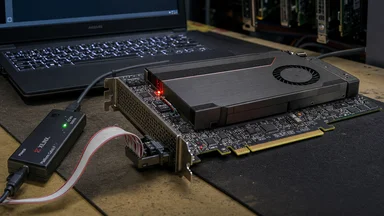
Teams discovered the failure only after a reboot cycle. Cards that had been running for weeks suddenly went dark during scheduled maintenance windows. In one lab, 18% of the fleet failed in a single weekend. The failure pattern was consistent: the card's PCIe link went down, and the host saw a fatal error. No remote recovery was possible—each card required a physical reflash using a JTAG adapter.
The vendor's field engineers flew overnight with programmers and laptops. In some cases, cards were installed in hard-to-reach chassis in automotive test facilities, requiring partial disassembly of server racks. Replacement lead time for new cards stretched to 14 weeks, so reflashing was the only option. The incident triggered an internal audit of driver QA processes and a budget overrun that reached into the millions.
Postmortem analysis traced the bug to a single line: the DMA descriptor count was calculated using a sizeof operator on a structure, but a newer revision of the card had increased the descriptor size without updating the ring allocation code. The off-by-one meant the driver programmed the card with a valid-looking but wrong length. The card's firmware accepted it, then hung when it tried to read past the ring.
The Hardware–Software Handshake Nobody Tests
The kernel module assumed hardware state that never held. The PCIe enumeration order varied between motherboard revisions, and the card's base address register was mapped differently on some platforms. The firmware team had no access to the target chassis during development—they tested on a single reference board that happened to work.
Integration testing used that one reference board with a specific BIOS version and CPU model. The driver passed all functional tests, including stress tests that ran for days. But the tests never exercised the exact combination of motherboard revision, PCIe slot number, and card firmware version that triggered the bug in production. The driver code was reviewed for style and logic, but not for race conditions or hardware-specific assumptions.
The DMA descriptor ring bug was a classic example of a hardware-software handshake that nobody tests because it's hard to reproduce. The card's firmware had no defensive checks—it trusted the driver to supply a valid ring size. When the driver lied, the card had no fallback. Some engineers argued the card should have sanity-checked the descriptor count, but the firmware team pointed out that the spec said the host was responsible for correctness.
This incident mirrors a pattern seen in many PCIe driver failures: the driver is developed and tested on a narrow set of hardware, then deployed to a heterogeneous fleet. The assumption that PCIe enumeration is deterministic across all platforms is false. Each motherboard revision, each BIOS version, each PCIe switch topology can change the memory-mapped layout that the driver depends on.
Consider a similar case from 2023: a network interface card driver had a bug where it assumed a fixed number of MSI-X interrupts, but a certain motherboard chipset reduced the available vectors. The driver allocated more vectors than available, causing interrupt storms that crashed the host. That bug was caught in pre-production testing only because the lab had a mix of motherboards. The lesson is that hardware diversity in testing is not optional—it is a requirement for reliable driver deployment.
How a $10,000 Card Becomes E-Waste in Seconds
Each card cost between $8,000 and $12,000. For a fleet of two thousand, the hardware value alone was roughly $20 million. But the real cost was operational: labs that depended on these cards for autonomous vehicle simulation and edge AI inference lost weeks of work. One automotive test facility had to rerun a full suite of driving scenarios, delaying a validation milestone by a month.
Field engineers flew overnight with JTAG programmers, but not all cards were easily accessible. In some data centers, cards were installed in dense chassis with limited clearance. Reflashing required powering down the entire server, extracting the card, attaching a programmer, and then reassembling. Each reflash took about 30 minutes, and with two thousand cards, that added up to roughly a thousand person-hours of hands-on work.
Replacement lead time stretched to 14 weeks because the card's custom ASIC was in short supply. The vendor had to prioritize new orders over warranty replacements, leaving some customers with dead cards in their racks for months. The budget overrun triggered an internal audit of driver QA, and the company's CTO personally reviewed the postmortem.
The incident also had a human cost. Engineers who had written the driver felt responsible. One described it as "the worst week of my career" in a private forum. The lead kernel developer was reassigned to documentation for three months, a move that some saw as punitive and others as a cooling-off period. Several team members left for startups promising safer development stacks.
To put the financial impact in perspective, consider the cost of downtime. For a single automotive test lab running 500 cards, the hardware loss was about $5 million, but the delay in validation added roughly $2 million in missed milestones and overtime for engineers. Across all affected sites, the total cost—including travel, reflashing labor, and lost productivity—likely exceeded $10 million. This does not account for the reputational damage and the loss of customer trust.
The Career After the Incident
The lead kernel developer, a senior engineer with a decade of experience, was moved to a documentation role. The company framed it as a temporary reassignment to improve driver documentation, but the engineer's colleagues saw it as a demotion. The incident had damaged trust in the driver team, and management wanted visible accountability.
Hiring was frozen for most roles, but the company immediately opened positions for hardware-validation engineers. The message was clear: software-only testing was no longer acceptable. The surviving engineers wrote a postmortem that became a playbook for the industry. It detailed every step of the failure, from the code change to the fleet-wide outage, and included recommendations for preventing similar incidents.
The company adopted mandatory hardware-in-loop testing for all PCIe drivers. Every driver update now runs on 50+ board variants, covering different motherboard revisions, CPU generations, and PCIe topologies. The test suite includes corner cases like hot-plug events and power state transitions that had never been tested before.
Some team members left for startups that were building safer development stacks. One startup focused on formal verification of DMA descriptor handling. Another built a hardware emulation platform that could simulate thousands of board configurations. The incident had a ripple effect across the industry, influencing how other companies approached driver validation.
However, the reassignment of the lead developer sparked debate. Some argued that punishing the individual was counterproductive because the bug was a systemic failure of testing infrastructure, not negligence. Others felt that accountability was necessary to restore confidence. This tension between individual blame and systemic improvement is a recurring theme in engineering postmortems. The company eventually revised its policy to focus on process changes rather than personnel actions, but the damage to the team's morale had already been done.
What 2026 Fleet Operators Do Differently
By 2026, most fleet operators have adopted staged rollouts for driver updates. The standard approach is a canary deployment to a small subset of cards, followed by a quarter of the fleet, then a full rollout. This phased approach would have caught the bug before it reached two thousand cards, but it requires infrastructure that many operators lacked in 2025.
Automated rollback circuits have been added to PCIe slot power rails. If a card fails to initialize after a driver update, the host can cycle power to the slot and fall back to the previous driver version. This hardware-level safety net prevents bricks by allowing recovery without physical intervention. Some vendors now include a dedicated microcontroller on the card that can reflash the firmware over an out-of-band channel.
Kernel modules are now signed and verified at the bootloader level. This prevents unauthorized or corrupted drivers from loading, but it also means that a buggy signed driver can still brick a card. The signing process includes a hardware-in-loop test as a gate. If the driver fails on any of the 50+ reference boards, the build is rejected.
An incident database shared across three competing vendors now tracks driver bugs and hardware quirks. The database is anonymized but includes enough detail to help engineers avoid known pitfalls. Some operators have used it to identify problematic card revisions before deploying them at scale. The collaboration is fragile—vendors are competitors—but the shared pain of bricked fleets has created a rare cooperative space.
Despite these advances, some operators resist staged rollouts because of the operational complexity. For example, a company managing 10,000 cards across 50 sites argued that canary deployments would require additional monitoring and coordination, adding overhead to every update. They preferred to rely on rigorous pre-release testing instead. This trade-off between safety and agility is a constant tension in fleet management. The off-by-one incident tilted the balance toward safety, but not every operator has adopted the same approach.
Lessons for Any Engineer Shipping Hardware-Aware Code
The first lesson is to assume your hardware is never the one you tested. PCIe enumeration, memory mapping, and interrupt routing vary across platforms. A driver that works on a single reference board is not a driver that works in production. Hardware-in-loop testing should be a requirement, not an afterthought.
Treat DMA descriptors as untrusted input from hardware. Even though the driver writes them, the hardware reads them. If the driver writes an invalid descriptor, the hardware will fail. Defensive programming means validating every descriptor field before handing it to the hardware, even if you think the driver is correct. The card should also have sanity checks, but you can't rely on that.
Instrument driver entry points with hardware state checks. After every DMA operation, verify that the hardware's state matches expectations. This adds overhead, but it catches bugs early. In the off-by-one case, a simple check that the descriptor ring pointer was within bounds would have caught the error before the card locked up.
Build a hardware-in-loop lab before you need one. The cost of a lab with 50 board variants is significant, but it's a fraction of the cost of a fleet-wide outage. If your company ships kernel modules that interact with PCIe hardware, you need a lab that represents your target fleet. There's no shortcut.
Plan for the day your code bricks a thousand devices. Have a recovery plan that doesn't require a field engineer with a JTAG programmer. Remote reflash over a sideband channel, power cycling with fallback, and redundant boot partitions are all mitigations that should be designed in from the start. The off-by-one bug was a one-line error, but the recovery effort lasted months. The best fix is to never ship the bug, but the second-best is to make it recoverable.
Some engineers argue that hardware-in-loop testing is too expensive for small teams. A counter-argument is that even a small team can use cloud-based hardware emulation services that simulate various board configurations for a fraction of the cost of a physical lab. For example, a startup now offers a PCIe emulation platform that allows running driver tests against virtual models of 100 different motherboards. This approach democratizes access to diverse hardware testing, but it cannot fully replace physical testing because emulators may not capture all timing behaviors.
The kernel module that disabled two thousand fleet cards was a wake-up call for the industry. It showed that even a tiny error in a DMA descriptor length can bring down a global fleet. The incident led to better testing, safer rollouts, and a shared database of failures. But the underlying problem remains: hardware-software boundaries are where the most insidious bugs hide, and catching them requires discipline that many organizations still lack. The engineers who lived through that week will never look at a driver patch the same way again.