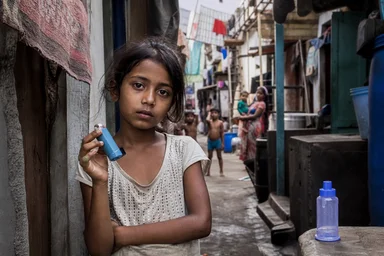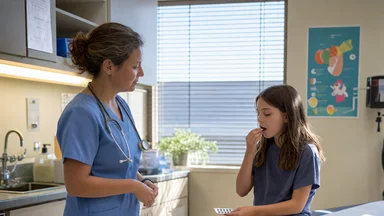
Rhea is seven years old and lives with her mother in a one-room home in Dharavi, Mumbai's sprawling slum. She has asthma, diagnosed when she was four. Her mother, a domestic worker earning around 300 rupees a day, buys a salbutamol inhaler every few weeks. Each inhaler costs about 300 rupees. But for the past six months, Rhea has been using half the doses she needs. The other half of the inhaler money goes toward her school fees. Rhea's mother told a community health worker that she feels torn: "If she doesn't go to school, she has no future. If she doesn't breathe, she has no life."
Seven-Year-Old Rhea Skips Inhaler Doses to Fund School Fees
Rhea's story is not unique. In Dharavi, where roughly 800,000 people live in cramped quarters, asthma is a common diagnosis. The narrow alleyways, indoor cooking fires, and damp walls create a perfect storm for respiratory illness. Rhea's mother works as a domestic help in a nearby high-rise, earning a daily wage that fluctuates between 250 and 400 rupees. She spends about 1,500 rupees a month on food, 500 on rent, and 300 on Rhea's inhaler. School fees add another 200 rupees per month. To cover all costs, she sometimes skips meals. But Rhea's inhaler is a recurring expense that she cannot ignore entirely.
Rhea has learned to ration her inhaler. She takes one puff in the morning instead of the prescribed two, and only uses it at night if she feels tightness. Her mother says the inhaler lasts three weeks instead of ten days. But the cost of this rationing is high: Rhea wakes up coughing most nights and cannot run with other children during recess. Her teacher has noticed she is often tired and misses school at least once a month due to breathlessness.
The decision to divert inhaler money to school fees is a calculated trade-off. Rhea's mother believes education is the only way out of the slum. She herself left school at age 12 to work. She wants Rhea to finish at least tenth grade. But without consistent asthma control, Rhea's attendance suffers. In the last term, she missed 12 days of school—some due to asthma attacks, others because her mother could not afford the inhaler and kept her home to avoid an episode.
Asthma Prevalence in Mumbai Slums: 8% of Children Affected
A 2019 study published in BMC Public Health estimated that roughly 8% of children living in Mumbai's slums have asthma. That is nearly double the prevalence among children in non-slum areas of the city. The study surveyed over 2,000 households and found that indoor air pollution from biomass cooking fuel, combined with damp housing and lack of ventilation, significantly increased risk. Only about 30% of affected children had regular access to inhalers. Most families relied on oral medications or home remedies.
Dr. Anjali More, a pediatric pulmonologist at Sion Hospital who worked on the study, explains: "The slum environment is a perfect storm. You have high exposure to dust mites, cockroach allergens, and smoke from kerosene stoves. Add in the stress of poverty, and you get a high burden of uncontrolled asthma." She notes that many children are diagnosed late, after repeated emergency visits. Rhea was diagnosed only after a severe attack that required hospitalization for two days.
The study also found that families often prioritise immediate needs over preventive care. An inhaler is seen as a reactive tool, not a preventive one. Many mothers told researchers they only bought an inhaler when their child was visibly struggling to breathe. The concept of daily preventive use—even when symptom-free—is not widely understood. Community health workers try to bridge this gap, but they are few relative to the need.
Inhaler Costs Equivalent to 5 Days' Wages for a Daily-Wage Earner
A single salbutamol inhaler costs around 300 rupees at a private pharmacy. For a daily-wage earner making 250–400 rupees per day, that is roughly one day's wages. But a combination inhaler containing fluticasone and salmeterol—a more effective preventive option—costs about 800 rupees, or two to three days' wages. For a family living hand-to-mouth, these costs are prohibitive.
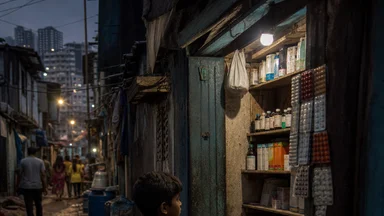
Government hospitals and clinics sometimes provide free salbutamol inhalers, but supply is erratic. Rhea's mother once waited four hours at a municipal dispensary only to be told the stock had run out. She ended up buying from a private pharmacy. The Jan Aushadhi scheme, which sells generic medicines at low prices, offers salbutamol inhalers for about 30 rupees, but awareness is low and availability is inconsistent. A 2022 survey by the Public Health Foundation of India found that only 12% of slum residents knew about Jan Aushadhi stores.
For a family like Rhea's, the choice between food and medicine is real. Her mother spends roughly 50 rupees a day on food for the two of them—mostly rice, lentils, and vegetables. An extra 300 rupees for an inhaler means cutting back on vegetables for a week. Rhea's mother says she sometimes borrows from neighbours to buy the inhaler, then pays back with interest. This cycle of debt and poor asthma control is common.
Rhea's Emergency Visits Quadruple After Reducing Inhaler Use
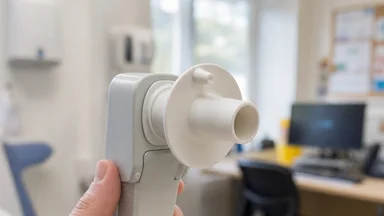
Since Rhea started rationing her inhaler, her emergency visits have increased. In the six months before she cut back, she had one emergency visit. In the following six months, she had three. Each visit to a private clinic costs 500–1,000 rupees, including consultation and medicines. The municipal hospital is cheaper but requires long waits and often lacks nebulisers. Rhea's mother loses a day's wages for each visit, adding to the financial strain.
Missed school days have also risen. Rhea missed 12 days in the last term, compared to 5 in the term before. Her teacher says she falls behind in maths and reading. The school does not have a nurse, and teachers are not trained to handle asthma attacks. When Rhea starts wheezing, she is sent home. This further disrupts her education and adds to her mother's worry.
The cycle is self-reinforcing: poor asthma control leads to more missed school and work, which reduces income, which leads to less money for inhalers, which worsens control. Dr. More calls this "the asthma-poverty trap." She says breaking the cycle requires affordable, reliable access to preventive inhalers and education on their use. Without that, children like Rhea fall further behind.
Community Health Workers Bridge Gaps with Education and Subsidized Inhalers
Sion Hospital runs an outreach program that trains community health workers—known as ASHAs—to identify children with uncontrolled asthma. They visit homes, teach families about triggers, and demonstrate how to use inhalers with spacers made from plastic bottles. They also provide subsidized inhalers at about 100 rupees each, funded by donations and hospital budgets.
Rhea's mother attended two sessions with an ASHA named Sunita. Sunita showed her how to use a spacer to improve drug delivery, reducing waste. She also explained that using the inhaler preventively—two puffs twice a day—could reduce attacks and ultimately save money. Rhea's mother was skeptical at first, but after a month of consistent use, Rhea had no emergency visits. The cost of two puffs per day is about 10 rupees, far less than an emergency visit.
But the program reaches only a fraction of those in need. Sunita covers about 200 households in her area, but estimates that at least 1,000 children in Dharavi need similar support. She says the biggest barrier is not just cost but also trust. "Many mothers think inhalers are addictive or weaken the lungs. We have to spend time explaining." The program has shown that with education and subsidized medicines, asthma control improves dramatically. But scaling up requires funding and political will.
Policy Gap: India's National Asthma Program Lacks Funding for Inhalers
India's National Programme for Prevention and Control of Non-Communicable Diseases (NPCDCS) has included asthma since 2010. However, the budget allocated is tiny—about 0.02% of total health spending, according to a 2023 analysis. Free inhalers are provided only in 15 pilot districts, and Mumbai is not among them. Advocacy groups like the Asthma and Allergy Foundation of India have been pushing for expansion, but progress is slow.
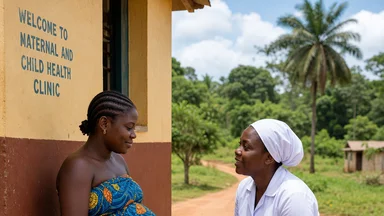
A 2021 report by the Ministry of Health noted that asthma is underdiagnosed and undertreated, especially in urban slums. It recommended integrating asthma care into primary health centres and training more ASHAs. But implementation is patchy. In Dharavi, there is one primary health centre for over half a million people. It has a doctor two days a week and rarely stocks inhalers.
Dr. More argues that the cost of providing free inhalers to all children in slums is relatively low. "A salbutamol inhaler costs the government about 30 rupees through bulk procurement. For 100 rupees per child per year, we could prevent most emergency visits." But the health budget is stretched thin, and asthma competes with tuberculosis, malaria, and maternal health. Until asthma is prioritised, families like Rhea's will continue to make impossible choices.
Practical Takeaway: Simple Steps Can Halve Asthma Costs for Slum Families
For families in similar situations, small changes can make a difference. Using a spacer—even a homemade one from a 500 ml plastic bottle—can double the amount of medicine reaching the lungs, reducing waste and the frequency of refills. Buying generic salbutamol from Jan Aushadhi stores can cut the cost from 300 to 30 rupees per inhaler. Keeping windows open during cooking and avoiding smoky fuels can reduce triggers. Tracking symptoms with a simple paper diary helps families recognise early warning signs and adjust medicine before an attack becomes severe.
Community health workers can teach these techniques, but families need access to them. Rhea's mother now buys generic inhalers from a Jan Aushadhi store about 2 km away, saving roughly 270 rupees per inhaler. She uses a spacer made from a water bottle. Rhea's emergency visits have dropped to zero in the past three months. Her school attendance has improved, and she can play for short periods without wheezing.
But these solutions are not a panacea. The spacer bottle must be cleaned regularly; the generic inhaler sometimes runs out of stock; and the Jan Aushadhi store is only open during certain hours. Systemic change—consistent supply, trained health workers, and adequate funding—is still needed. Until then, families will continue to make trade-offs that no parent should have to face.
Counter-Argument: Is Rationing Inhalers a Rational Choice?
Some might argue that Rhea's mother is making a rational economic decision. School fees are a fixed cost; skipping them leads to immediate expulsion. Inhaler doses can be reduced gradually, and the risk of an attack seems manageable in the short term. In a study by the Indian Institute of Technology Bombay, researchers found that slum families often employ a "risk ladder"—prioritizing expenses that have immediate, severe consequences over those with delayed or probabilistic outcomes. For Rhea's mother, paying school fees ensures her daughter stays enrolled, while skipping inhaler doses might only cause problems later.
This perspective highlights a deeper issue: the lack of a safety net. If Rhea's mother had access to emergency health insurance or a school health program, she might not have to choose. But in the absence of such support, her decision is a survival strategy. The problem is not her logic but the system that forces such trade-offs.
Trade-Off Analysis: Education vs. Health in Slum Communities
The conflict between education and health is not limited to asthma. In Dharavi, families frequently face similar dilemmas: buying glasses for a child with poor vision versus paying for tuition, or treating a persistent infection versus buying school supplies. A 2022 survey by the Dharavi Project found that 45% of households had at least one child who missed medical treatment in the past year due to school-related costs. The ripple effects are profound: untreated health issues lead to chronic absenteeism, which undermines the very education families sacrifice for.
For example, another child in Rhea's neighborhood, nine-year-old Arjun, has severe myopia. His mother spent money on a tutor instead of glasses, hoping to improve his grades. But Arjun could not see the blackboard, fell behind, and eventually dropped out. Now his mother regrets the choice. These stories illustrate that the education-health trade-off is often a false dichotomy: investing in one without the other can lead to losing both.
Data Point: Cost-Effectiveness of Preventive Asthma Care
A 2023 study by the World Health Organization estimated that every rupee spent on preventive asthma care in low-income settings saves 7 rupees in emergency costs. For Rhea, using her inhaler as prescribed would cost about 300 rupees per month, while her emergency visits cost 500–1,000 rupees each. Over six months, the preventive approach would total 1,800 rupees, compared to potentially 3,000 rupees for three emergency visits plus lost wages. The savings are clear, but require upfront cash that families may not have.
This is where micro-loans or community savings groups could help. In a pilot program in Pune, families received small interest-free loans to buy preventive medicines, and repayment was tied to school attendance. The program reduced emergency visits by 60% and improved attendance by 30%. Scaling such models to Dharavi could transform the asthma-poverty trap into a virtuous cycle.
Alternative Angles: How Schools Can Support Asthmatic Children
Schools in slums rarely have health infrastructure, but some innovative approaches exist. In Chennai, a non-profit trained teachers to administer emergency inhalers and keep a stock of salbutamol. The program reduced school-day asthma emergencies by 70% and cost only 50 rupees per child per year. A similar program in Dharavi could allow children like Rhea to stay in school even during mild attacks, reducing missed days. However, it requires buy-in from school administrators and training for teachers, who are already overburdened.
Another approach is school-based health camps. In Mumbai, the NGO Akanksha Foundation conducts annual health screenings in slum schools, identifying children with asthma and providing free inhalers. Rhea's school does not participate, but if it did, her mother might not have to choose between the inhaler and fees. Advocacy groups are pushing for mandatory health screenings in all municipal schools, but progress is slow due to budget constraints.
This article is for informational purposes only and does not constitute medical advice. Always consult a qualified healthcare provider for diagnosis and treatment of asthma or any other medical condition.