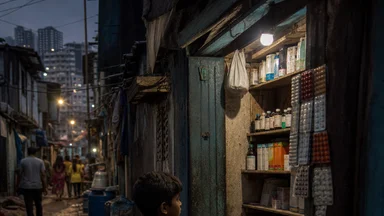
Eleven-year-old Sunil lives with his mother and two younger siblings in a single room in Dharavi, Mumbai's sprawling slum. For weeks, he has been coughing—a wet, rattling cough that sometimes leaves specks of blood on his pillow. His mother, a domestic worker earning roughly 6,000 rupees a month, cannot afford to miss a day's wages to take him to the public clinic, which is a two-hour bus ride away. A neighbour tells her about a pharmacy in the narrow lanes of the slum—no signboard, no license—where she can buy tuberculosis drugs without a prescription. She pays 300 rupees for a strip of rifampicin, the first-line TB drug. Sunil starts taking the pills that night.
Mumbai's Black Market TB Drugs Are the Only Option for Sunil
Sunil's story is not unusual in Dharavi, where an estimated 700,000 people live in an area of just over two square kilometres. The nearest public health centre, run by the Municipal Corporation of Greater Mumbai, is about three kilometres away. For many residents, the cost of a round-trip rickshaw fare—roughly 50 rupees—plus lost wages makes regular visits impossible. The black market pharmacy, by contrast, is a ten-minute walk from Sunil's home. It operates from a cramped room behind a cloth shop, open from early morning until late at night.
The pharmacist, a man in his forties who gives only his first name, Rajesh, says he sells TB drugs to at least five customers a day. He obtains his stock from wholesalers in the city's wholesale drug market, often buying expired or near-expiry batches at a discount. He does not ask for prescriptions. He does not keep records. He charges 300 rupees for a month's supply of rifampicin—about half the price at a legal private pharmacy, but still a significant expense for Sunil's mother.
Sunil's mother, who asked not to be named for fear of reprisals, says she knows the drugs might not be genuine. But she has no choice. The public clinic, she says, is often out of stock of TB medicines. When they do have them, the waiting time can be four hours or more. She cannot afford that. She also cannot afford the 2,000 rupees a private lab charges for a GeneXpert test, the gold standard for diagnosing TB. The black market pharmacy offers a quick fix, even if it is a risky one.
India's TB Crisis Pushes Families into Informal Channels
India accounts for roughly 26 percent of the global tuberculosis burden, according to the World Health Organization's 2025 Global TB Report. That is about 2.8 million new cases each year. The country's public health system, despite ambitious targets under the National TB Elimination Plan, remains underfunded and understaffed. A 2023 report by the Indian Council of Medical Research found that public clinics in Mumbai's slums have, on average, one doctor per 10,000 patients. Stockouts of first-line TB drugs are reported in roughly 20 percent of facilities surveyed.
Private labs, which offer faster and more accurate diagnostics, charge fees that are out of reach for families like Sunil's. A GeneXpert test, which can detect TB and drug resistance in under two hours, costs around 2,000 rupees in Mumbai's private sector—more than a third of Sunil's mother's monthly income. As a result, many patients either go undiagnosed or seek treatment through informal channels. The black market fills a gap that the public system has left open.
The scale of the problem is hard to quantify. Police in Mumbai estimate that the city has roughly 300 illegal pharmacies, many of them concentrated in slums like Dharavi, Govandi, and Mankhurd. These pharmacies operate without licenses, without oversight, and without any guarantee of drug quality. They are often the first—and sometimes only—point of care for residents who cannot navigate the formal health system.
Substandard Drugs Fuel Drug-Resistant TB Cycle
The pills Sunil is taking may not contain the right dose of rifampicin—or any at all. A 2024 study published in PLoS Medicine tested 150 samples of TB drugs purchased from informal vendors in Mumbai and found that 19 percent failed quality tests, either because they contained too little active ingredient or because they had degraded due to improper storage. Substandard drugs do not cure TB. Instead, they allow the bacteria to survive and develop resistance.
Incomplete or inadequate treatment is the primary driver of multidrug-resistant TB (MDR-TB), a form of the disease that is far harder and more expensive to treat. According to WHO, India has roughly 120,000 cases of MDR-TB each year, the highest of any country. Treatment for MDR-TB costs roughly 40 times more than for drug-sensitive TB—around 200,000 rupees per patient—and has a cure rate of only about 55 percent. For children like Sunil, the prognosis is even worse. Pediatric MDR-TB is often diagnosed late, and the drugs available are not always formulated for children's bodies.
Sunil's mother does not know whether the pills she bought are genuine. She says he has been taking them for two weeks, and his cough has not improved. She is worried, but she does not know where else to go. The black market pharmacy is her only lifeline, even if it might be making him sicker.
Mumbai's Slum Health Infrastructure Fails Children
Dharavi has one public clinic for roughly every 50,000 residents, according to data from the Municipal Corporation. There is no pediatric TB specialist within a ten-kilometre radius. The closest hospital with a dedicated TB ward is Sion Hospital, about five kilometres away, but the waiting list for outpatient appointments can stretch to weeks. For Sunil's mother, who works six days a week as a domestic helper, taking a day off means losing 200 rupees in wages—money the family needs for food and rent.
Directly observed therapy (DOT), the standard of care for TB treatment, requires patients to visit a health facility daily to take their medication under supervision. For a family living in Dharavi, that means a two-hour round trip each day, plus lost wages. Unsurprisingly, adherence rates in slum communities are low. A 2022 study in the Indian Journal of Tuberculosis found that only about 60 percent of patients in Mumbai's slums completed their full course of treatment. The rest either dropped out or sought care from informal providers.
The consequences are severe. Incomplete treatment not only fails to cure the individual but also increases the risk of drug-resistant strains spreading in the community. Children, who are more susceptible to infection and often present with atypical symptoms, are particularly vulnerable. Sunil's case is a textbook example of how systemic failures cascade down to the most vulnerable.
A Pilot Project in Govandi Offers a Better Model
In the neighbouring slum of Govandi, a pilot project run by a non-profit organization in partnership with the municipal corporation offers a different approach. Community health workers go door-to-door, screening residents for TB symptoms. A mobile X-ray van, funded by a private donor, visits the area twice a month, reaching roughly 2,000 people each time. Patients diagnosed with TB are given free drugs delivered to their homes, and health workers visit daily to ensure adherence. The programme reports an 85 percent treatment completion rate, far above the city average.
The cost of the programme is roughly 500 rupees per patient per month—about the same as a month's supply of black market drugs. But it covers diagnostics, medication, and follow-up. For families like Sunil's, it would eliminate the need to choose between treatment and wages. The programme has been running for two years and has treated over 1,000 patients. Yet Sunil's family has never heard of it.
Community health workers in Govandi say they try to cover every household, but the area is vast and resources are limited. They have a list of roughly 15,000 families, but many are missed on each round. Sunil's family, living in a makeshift structure on the edge of Dharavi, is not on their radar. The programme has no official mandate to expand beyond Govandi, and funding is uncertain beyond the current year.
Regulatory Loopholes Allow Rogue Pharmacies to Thrive
Mumbai's black market pharmacies operate in a regulatory vacuum. The city has roughly 300 illegal pharmacies, according to police estimates, but drug inspectors cover only about 10 percent of premises annually. The state's drug control department has just 50 inspectors for the entire Mumbai metropolitan area, a jurisdiction of over 20 million people. Wholesalers, who supply both legal and illegal pharmacies, are supposed to maintain records of all sales, but enforcement is lax. A 2023 sting operation by a local news outlet found that several wholesalers in the city's main drug market were selling expired stock to dealers without asking for licenses.
There is no tracking system for TB drug sales. Unlike narcotics, which are monitored under the Narcotic Drugs and Psychotropic Substances Act, TB drugs are classified as Schedule H drugs, which require a prescription but are not subject to real-time tracking. This makes it easy for illegal pharmacies to stock and sell them without detection. Even when inspectors do raid illegal pharmacies, the penalties are light. Most dealers are fined a few thousand rupees and resume business within days.
The black market is not just a problem of supply; it is a symptom of demand. As long as public clinics remain understaffed, understocked, and inconvenient, families will seek alternatives. Closing illegal pharmacies without addressing the underlying gaps in the health system would simply push patients to even more dangerous sources.
Scaling Decentralized Care Could Cut Black Market Demand
The Govandi pilot shows that decentralized, community-based care can work. It costs roughly 500 rupees per patient per month, a fraction of the cost of treating a case of MDR-TB. Scaling it to cover all of Mumbai's slums would require an estimated annual budget of roughly 200 million rupees—a small sum compared to the economic losses from TB, which the World Bank estimates at over $12 billion per year in India. Yet the National TB Elimination Plan, which aims to end TB by 2025, is off track. As of late 2024, only about 60 percent of estimated cases were being notified to the government, and treatment success rates for drug-sensitive TB have stagnated at around 80 percent.
Sunil's story is a case for urgent scale-up. He is one of thousands of children in Mumbai's slums who fall through the cracks of a system that is supposed to catch them. The black market is not a solution; it is a symptom of failure. But in the absence of accessible, affordable, and reliable public health services, it is the only option many families have. Until the government invests in community-based care, door-to-door screening, and home delivery of drugs, children like Sunil will continue to buy black market pills that may not work, fueling a cycle of drug resistance that threatens everyone.
Trade-Offs and Counter-Arguments: Is Decentralized Care Always Feasible?
While the Govandi pilot demonstrates clear benefits, scaling such programmes citywide faces significant hurdles. First, funding remains a major challenge. The pilot relies on private donors, and government budgets are already stretched. Critics argue that diverting resources to community-based care might weaken existing facility-based services, which are essential for severe cases requiring hospitalization. For instance, patients with complications like TB meningitis need specialist care that community health workers cannot provide. A balanced approach might involve strengthening both community and hospital systems, but that requires even more funding.
Second, the quality of care in decentralized models can vary. Community health workers, often with minimal training, may miss subtle signs of drug resistance or side effects. A 2023 study in The Lancet found that while community-based TB care improves adherence, it does not always improve cure rates if diagnostic accuracy is low. In Govandi, the programme uses mobile X-ray vans and GeneXpert tests, but replicating this equipment across all slums would be costly. Without reliable diagnostics, home-delivered drugs could still be ineffective, just like black market pills.
Third, there is the risk of over-reliance on informal providers. Some public health experts argue that instead of bypassing the black market, the government should regulate and integrate existing informal pharmacies into the formal system. For example, a pilot in Kenya trained informal drug sellers to refer TB suspects and dispense approved drugs under supervision. This approach could leverage the convenience that illegal pharmacies currently offer, while ensuring drug quality. However, such integration requires trust and oversight, which are lacking in Mumbai's fragmented health landscape.
Sunil's mother, if given the choice, would prefer a community health worker who visits her home and provides free, guaranteed drugs. But she also worries about privacy—neighbours in the cramped slum might see the health worker and gossip about TB, which carries stigma. Decentralized care must address such social barriers. In Govandi, health workers are trained to maintain confidentiality, but in a place like Dharavi, where families live in close quarters, stigma can deter people from accepting home visits. A 2022 survey in Mumbai slums found that 30 percent of TB patients feared discrimination, leading some to avoid treatment altogether.
Despite these challenges, the case for scaling decentralized care remains strong. The cost of inaction is higher: each untreated case of drug-sensitive TB can infect 10 to 15 people per year, and each MDR-TB case costs the health system hundreds of thousands of rupees. The Govandi pilot shows that with proper design, community-based care can achieve high completion rates at low cost. The key is to adapt the model to local contexts, invest in training and diagnostics, and pair it with public awareness campaigns to reduce stigma.
For Sunil, none of these policy debates matter right now. He is still coughing, still taking pills of unknown quality, and still at risk of developing drug-resistant TB. His mother continues to work six days a week, hoping that the black market drugs will somehow work. The system has failed them, but the Govandi pilot offers a glimpse of what could be. Whether that glimpse becomes a reality for Sunil and thousands like him depends on political will, sustained funding, and a willingness to learn from what works.
This article is for informational purposes only and does not constitute medical advice. Readers should consult a qualified health professional for any health concerns.